In May 2026, the evening sky is the best haven for seeing the planets, since the morning sky has the problem of the horizon-hugging ecliptic keeping Mars, Saturn and Neptune low as they re-emerge from behind the Sun.
Uranus is in solar conjunction in May 2026 (passing behind the Sun, from Earth’s perspective), which leaves Mercury, Venus and Jupiter.
Mercury isn’t too bad towards the end of May, and Venus is improving too, but as it separates from
the Sun, a lowering ecliptic angle will force the planet to lose altitude.
Read more


Jupiter remains well-placed at the start of May 2026 and is observable from around 22:30 BST (21:30 UT), when it will appear around 30° above the western horizon.
It sets around 02:15 BST (01:15 UT) at the start of the month, shining brightly at mag. –2.0. Jupiter manages to maintain this brightness for most of May.
On 20 May at 13:45 BST (12:45 UT), under daylight conditions, a 19%-lit waxing crescent Moon sits 2.6° north of Jupiter, with the Moon remaining nearby as the evening darkness arrives.

Venus and Jupiter are set for conjunction on 9 June and their apparent separation can be seen to noticeably close throughout May.
Find out more about this with our guide to observing Venus and Jupiter in May 2026.
By the end of the month, both planets will appear a little under 9° apart but will only be visible under darkening twilight conditions.
Jupiter remains within the borders of Gemini all month, visible just to the south of the celestial twins Castor (Alpha (α) Geminorum) and Pollux (Beta (β) Geminorum).
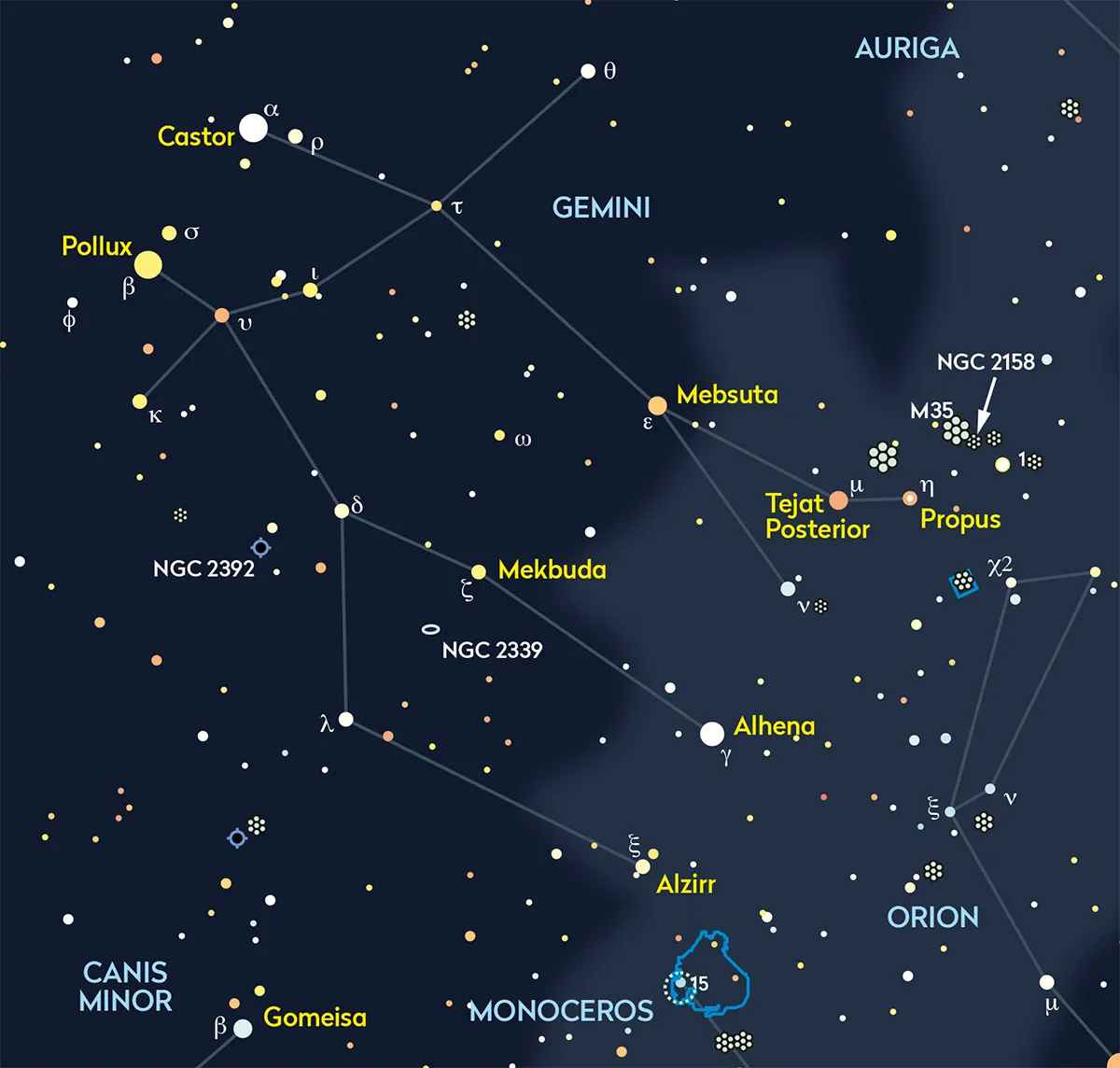
Jupiter, May 2026 at a glance
- Best time to see: 1 May, from 22:00 BST (21:00 UT)
- Altitude: 35°
- Location: Gemini
- Direction: West
- Features: Complex, banded atmosphere, four largest moons
- Recommended equipment: 70mm or larger
If you observe Jupiter in May 2026, share your observations and images with us by emailing contacts@skyatnightmagazine.com