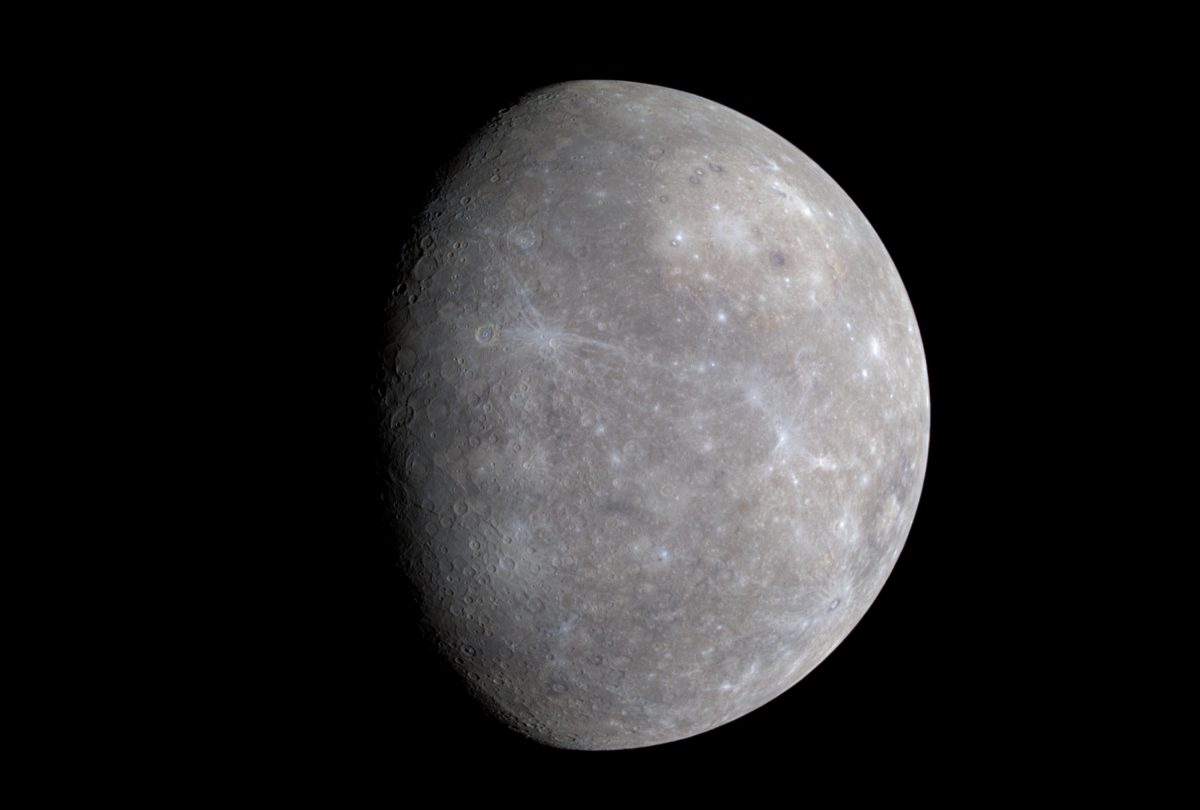
It’s small. It’s dense. It’s hot. But most of all, the innermost planet in our Solar System is mysterious.
So far, tiny Mercury, the first rock from the Sun, has only been visited by two spacecraft – far fewer than have explored Mars, Venus or even Jupiter. But things are about to change.
On 21 November 2026, after an eight-year journey, the European/Japanese BepiColombo mission will finally enter orbit around this crater-covered world, studying its fascinating geology and feeble magnetic field.
"“There’s still a huge amount to be learned," says lead project scientist Geraint Jones.
More on Mercury
A brief history of our relationship with Mercury
Chances are that you’ve never actually seen Mercury. If so, you’re in good company.
Rumour has it that famous 16th-century Polish astronomer Nicolaus Copernicus also never set eyes on the planet.
That’s because Mercury’s 88-day path around the Sun lies well inside Earth’s orbit, so from our vantage point, it always appears close to the Sun in the sky and often hidden in its glare.
But although it can only be seen during dusk or dawn, the fast-moving planet was known to Babylonian astrologers thousands of years ago.
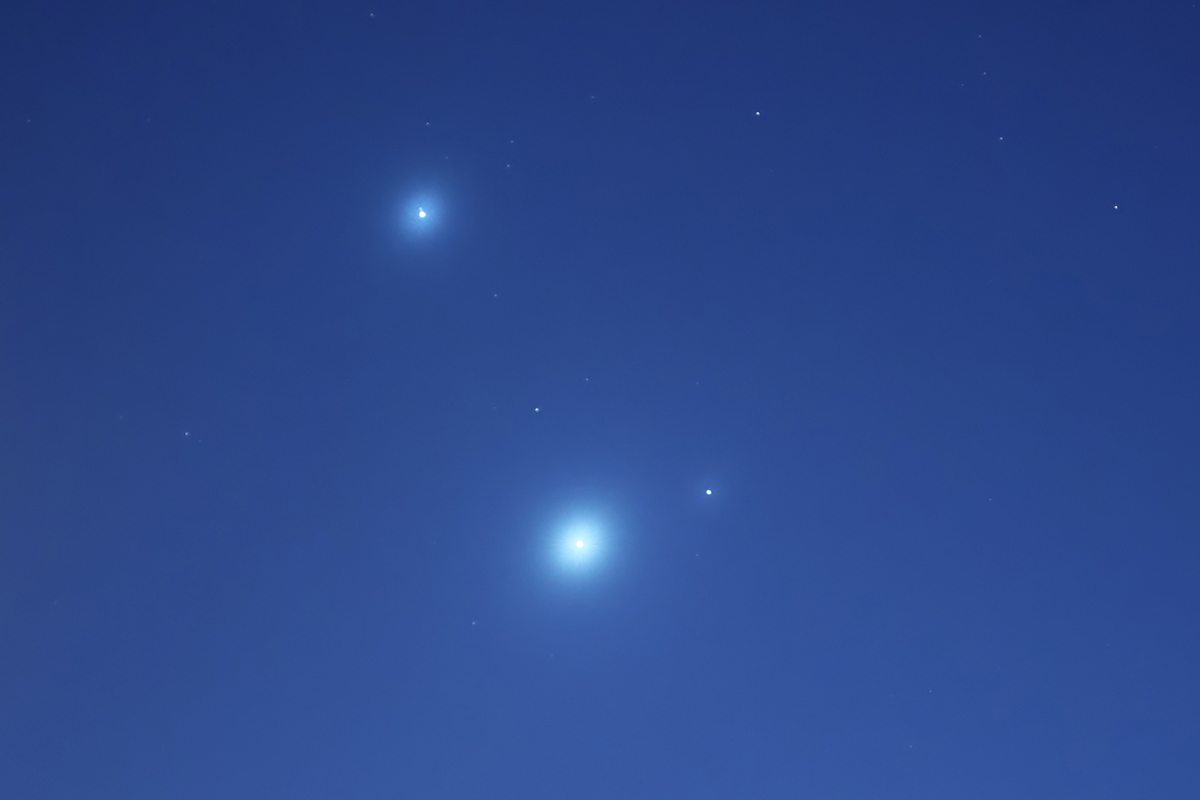
The Romans named it Mercury after their winged messenger-god, known to the Greeks as Hermes.
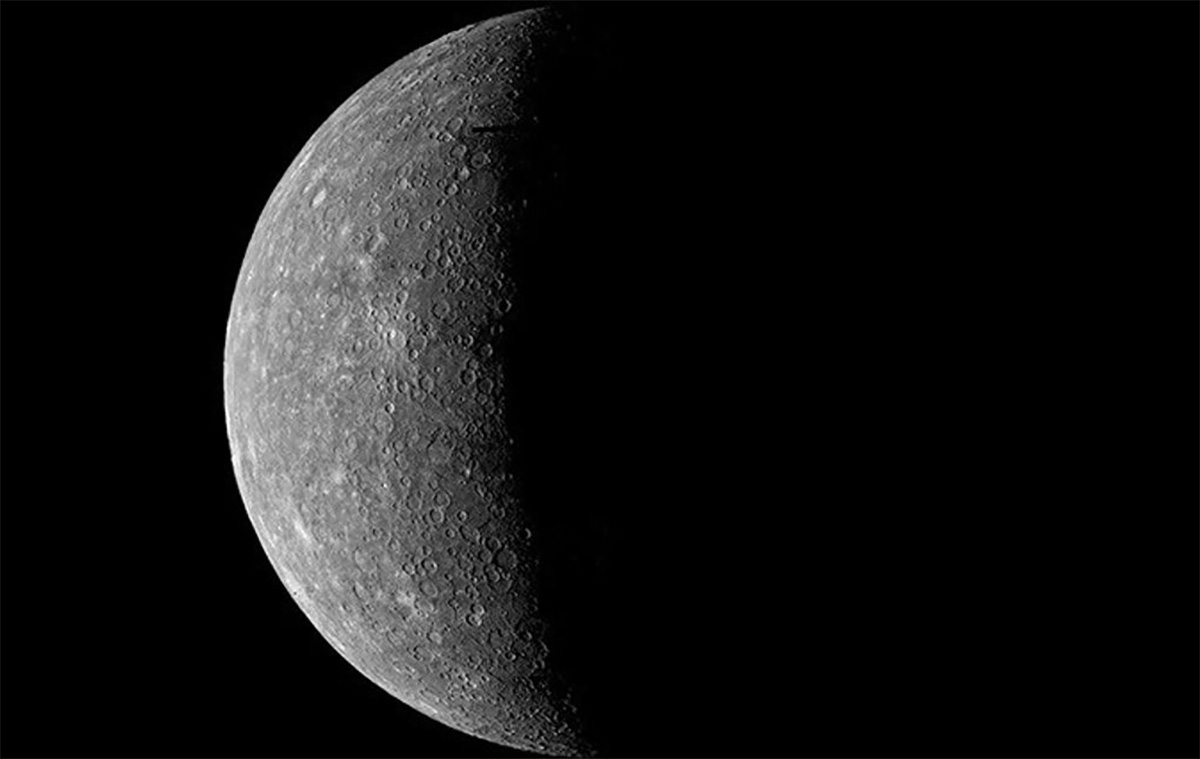
In 1612, German astronomer Simon Marius used a homemade telescope to discover the planet’s Moon-like phases, the result of its varying illumination by the Sun.
Ever since the start of the 19th century, keen-eyed astronomers have tried to discern surface details on little Mercury, which is just 4,880km (3,030 miles) in diameter.
In the 1930s, Greek astronomer Eugène Antoniadi even drew up maps of the planet, showing dark and bright regions that led him to believe Mercury always keeps one side directed to the Sun, similar to the so-called synchronous rotation of the Moon around Earth.
Exploration of Mercury, revealing the planet's secrets
In the early 1960s, all our knowledge of Mercury fitted easily on a beer mat, and some was outright wrong.
That became evident in 1965, when radar observations from Earth revealed something startling: the planet completes just three rotations around its axis for every two orbits around the Sun.
As a result, every point on the planet’s surface experiences 88 days of bright daylight followed by 88 days of utter darkness, with temperatures ranging between –170°C and +430°C (–274ºF to +806ºF).
More surprises came in 1974 and 1975, when NASA’s Mariner 10 spacecraft completed three close approaches to the planet while orbiting the Sun.
By studying the precise way in which the craft’s orbit was deflected by Mercury’s gravity, researchers discovered that the planet harbours a huge metallic core.
It measures some 4,000km (2,485 miles) across and takes up a staggering 57% of Mercury’s volume, compared to 17% in the case of Earth’s core.
Mariner 10 also detected a global magnetic field, albeit very weak, which is probably generated in the partially melted core.
According to Jones, the origin of Mercury’s large core is still an unsolved mystery.
One popular explanation holds that the planet was born much larger than it is now, and that a catastrophic collision with another planetary body flung most of its rocky mantle into space, leaving the original iron-rich core with a relatively thin silicate mantle.
"New data from BepiColombo will hopefully show us how well this theory holds," says Jones.
NASA’s second Mercury mission, MESSENGER (a convoluted acronym of MErcury Surface, Space ENvironment, GEochemistry, and Ranging) launched in August 2004, and in March 2011 became the first craft to orbit the planet.
For four years, it mapped the whole surface (Mariner 10 had only photographed some 45%) and studied its chemical composition.
Its instruments also confirmed the presence of ice deposits in permanently shadowed craters close to the planet’s poles, first suggested by terrestrial radar observations in the early 1990s.
A world of scars and hollows
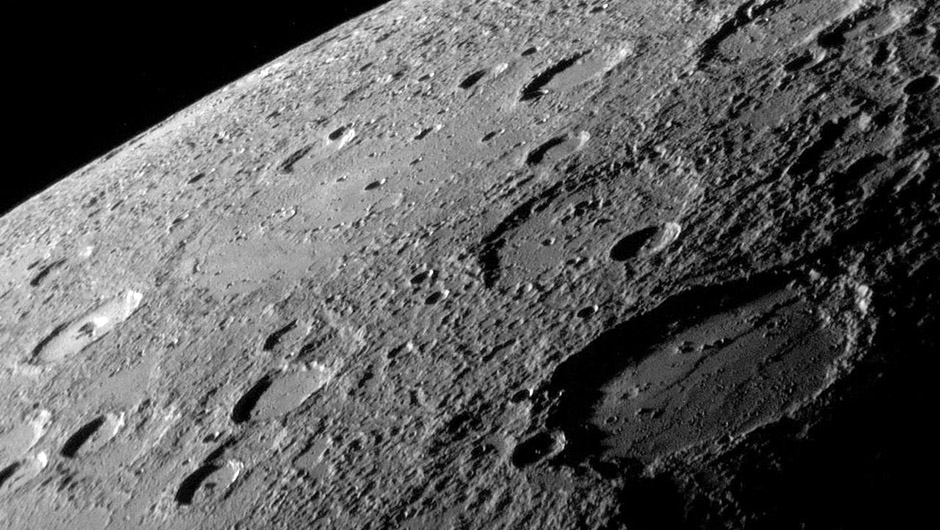
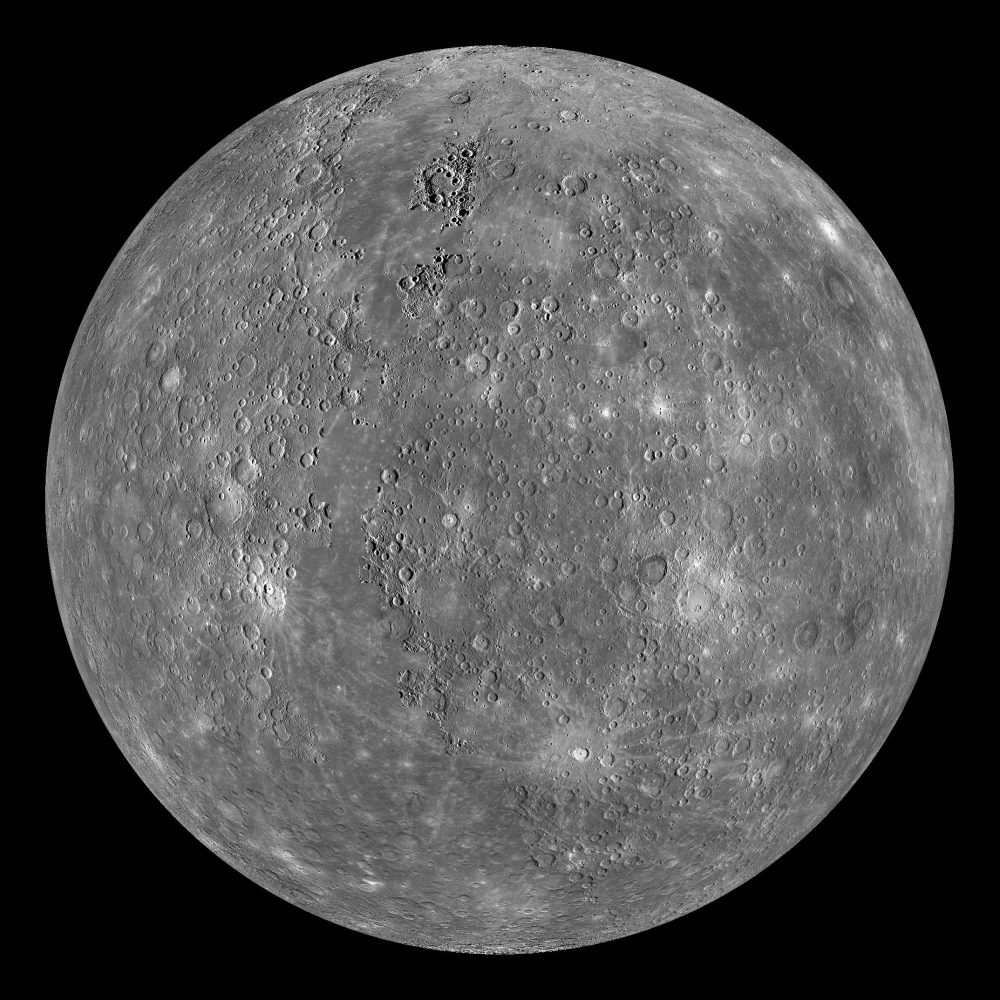
Mercury’s heavily cratered surface strongly resembles the Moon’s, but there are important differences.
The planet lacks the large, relatively crater-free lava plains that dominate the near side of the Moon, although geologists have found numerous traces of ancient volcanism, including pyroclastic flows.
Sinuous compression faults (sometimes known as ‘wrinkle ridges’) tens of kilometres long and up to a few kilometres high indicate that the planet has shrunk in on itself by a few kilometres as it cooled down over the aeons.
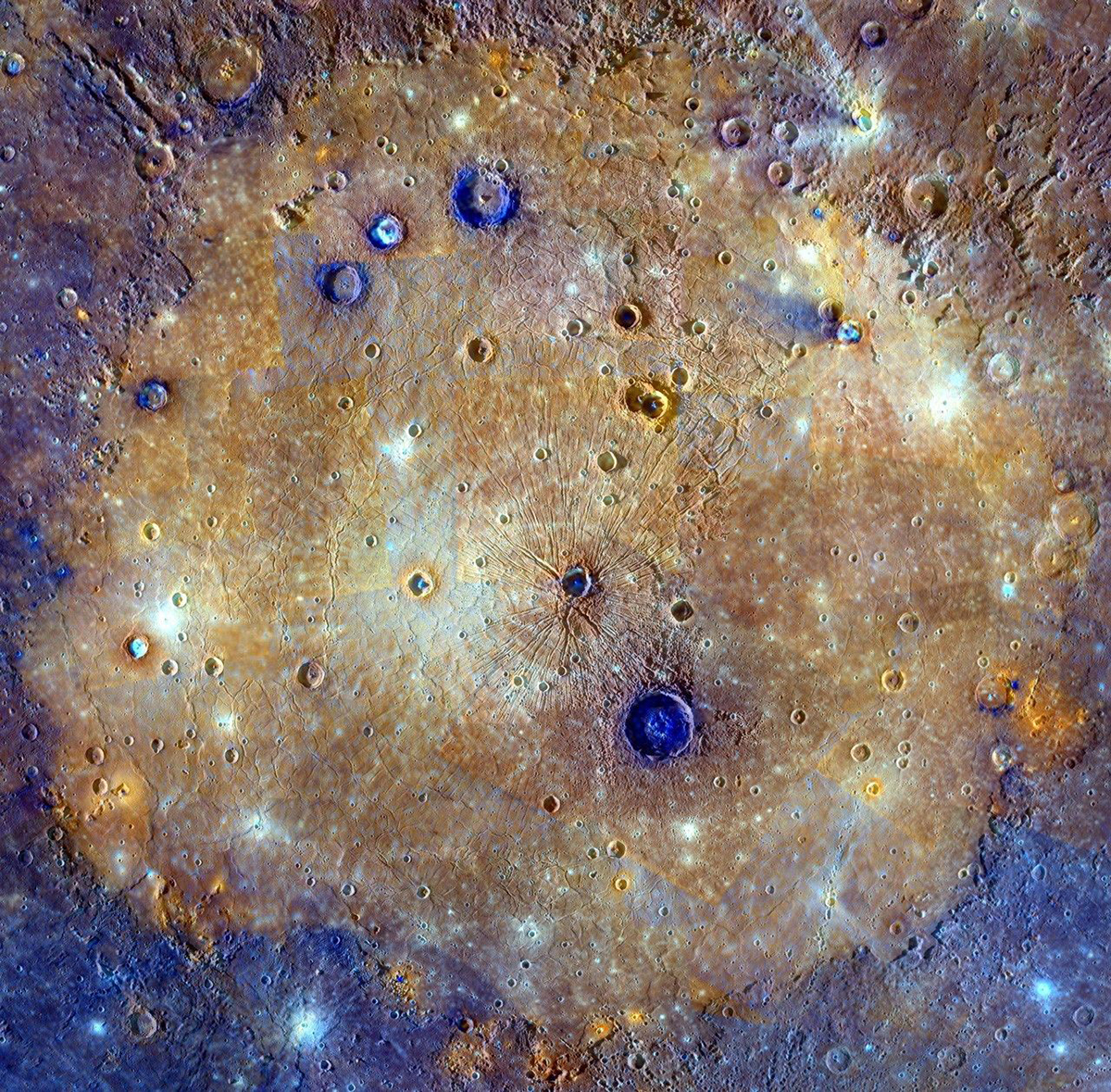
Apart from countless craters, almost all of which are named after painters, composers and other artists, Mercury sports dozens of large impact basins, including 1,550km-wide (960-mile) Caloris Planitia, one of the largest impact structures in the Solar System.
MESSENGER also found mysterious sinkhole-like ‘hollows’ that likely formed when volatile compounds sublimated under fierce sunlight.
"It’s as if the surface has literally been eaten away," says Jones. “The hollows are a unique feature to Mercury."
Because of its high temperature and low surface gravity (just 38% that found on Earth), Mercury is unable to hold onto much of an atmosphere.
Instead, it is surrounded by an extremely tenuous, extended exosphere. This is made up of hydrogen and helium atoms temporarily captured from the solar wind by the planet’s feeble gravity, and heavier atoms from the surface, including oxygen, sodium and calcium, released by meteorite impacts.
Mercury’s magnetic field, which is around 100 times weaker than Earth’s, still manages to capture charged particles from the Sun to create a relatively tiny magnetosphere, although it’s unable to protect its surface from an intense bombardment of solar wind and cosmic rays in the way that Earth’s does.
Two missions in one
BepiColombo, a joint project of the European Space Agency (ESA) and the Japanese space agency JAXA, is humanity’s third mission to Mercury.
Selected by ESA in 2000 as the last highlight of the agency’s Horizon 2000+ programme, the 4,100kg (9,040lb) spacecraft was launched on 20 October 2018, on a European Ariane 5 rocket.
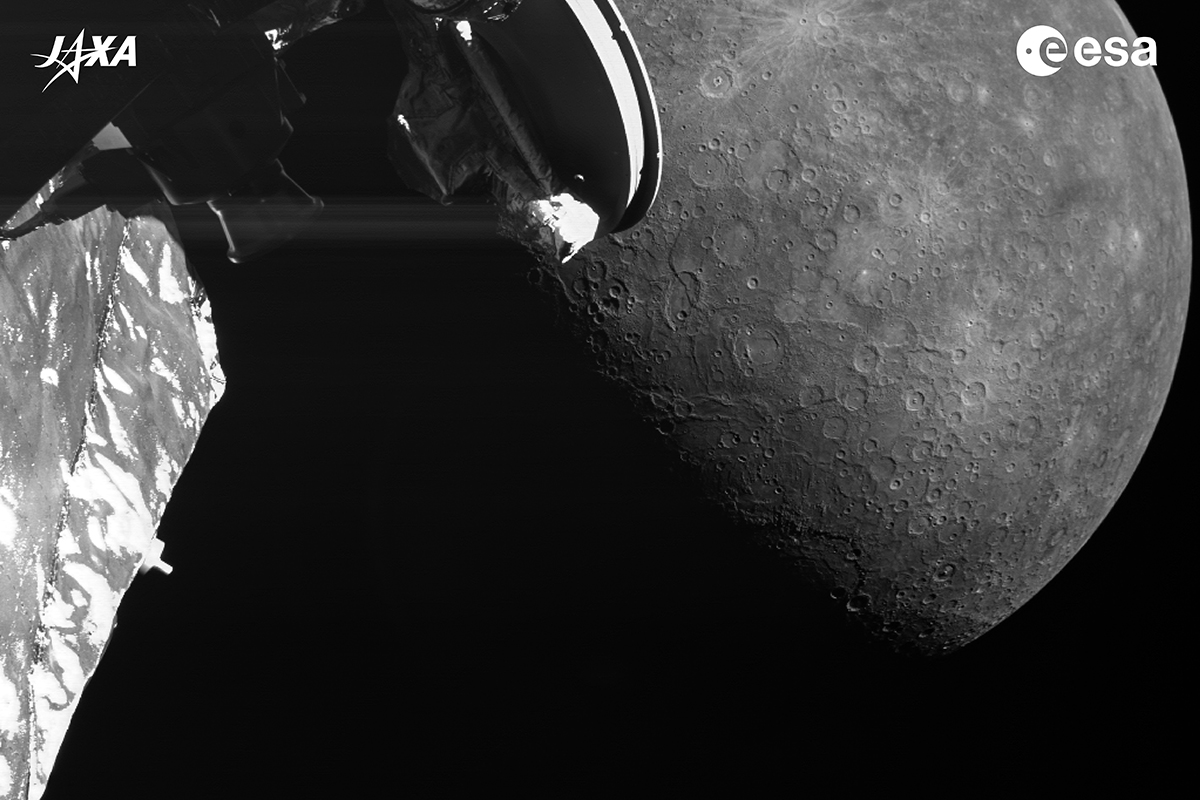
Before arriving at Mercury, it made one swing-by of Earth, two of Venus and six of Mercury itself – the last one in January 2025.
The Mercury fly-bys have already yielded many scientifically interesting results, including high-resolution imagery of the planet’s north pole.
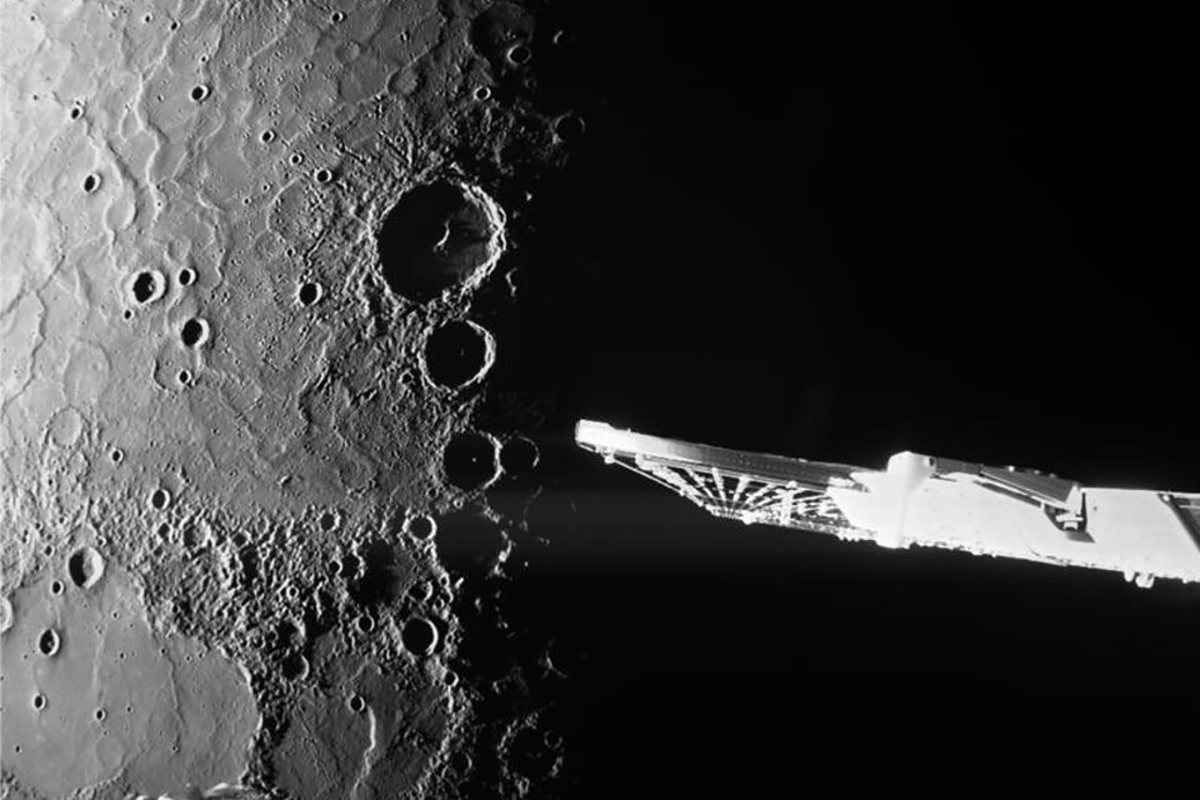
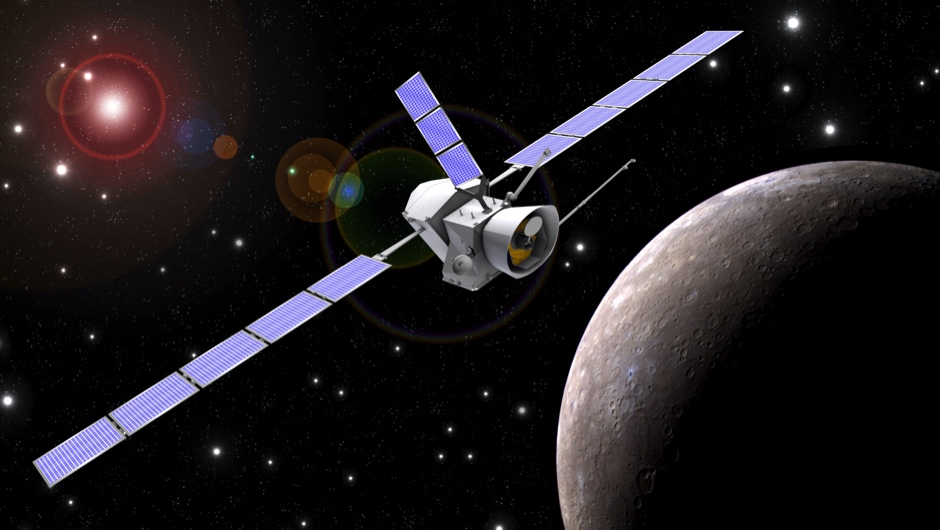
What makes BepiColombo special is that it’s really two missions for the price of one.
"It’s the first time we’ll deliver two separate probes in orbit around Mercury," says mission manager Santa Martinez.
The largest is the Mercury Planetary Orbiter (MPO), built by ESA and outfitted with a suite of 11 science instruments to study the planet’s surface and geology from a low 2.3-hour polar orbit.
Apart from a high-resolution camera, these include a laser altimeter to precisely map Mercury’s topography, and an X-ray spectrometer to measure the chemical composition of the planet’s surface.
Meanwhile, a thorough study of Mercury’s magnetic field and plasma environment is the main goal of the Mercury Magnetospheric Orbiter (MMO), nicknamed Mio.
Mio is the Japanese part of the mission, although its magnetometer instrument was built in Austria. The small octagonal craft also carries a dust monitor.
Mio will take 9.3 hours to complete its much larger, elliptical orbit. On 3 September 2026, a spring mechanism successfully released the dual spacecraft from the Mercury Transfer Module (MTM) that had transported BepiColombo all the way to Mercury.
Ignacio Tanco, ESA’s head of inner Solar System mission operations, described that critical milestone as “the launch of a new spacecraft”.
Still attached to each other, MPO and Mio will be captured into a highly elliptical polar orbit around Mercury on 21 November.
Credit: ESA/ATG medialab; Mercury: NASA/JPL
Arrival at last
After the two orbiters separate, on 9 or 10 December 2026, the European one will be slowly manoeuvred into its final orbit, which it will reach on 10 March 2027.
Regular science operations, from altitudes between 480km and 1,500km (300–930 miles) are set to commence on 6 April and last for at least one year, with a possible extension to late 2029.
Planetary scientists expect BepiColombo to teach them much more about the behaviour of an airless, rocky, magnetised planet so close to its parent star.
One of the things Jones is interested in is the response of the magnetosphere to explosions on the Sun and to meteorite impacts on the planet’s surface.
"Having two spacecraft working simultaneously will help enormously," he says.
But he also looks forward to learning more about the polar ice deposits, the weird hollows, the interior composition of the overly dense planet, and its complex geologic history.
"Mercury is the least understood of the four terrestrial planets," Jones comments. Hopefully, BepiColombo is going to solve many of the planet’s outstanding mysteries.
The road to Mercury
Most of the time, Mercury is the planet closest to Earth (Venus can get closer, but only occasionally). So why did BepiColombo take eight years to get there? It’s all to do with gravity.
For a spacecraft to reach Mercury, it has to follow an elliptical path that starts at Earth and eventually takes it much closer to the Sun.
As it falls into the Sun’s gravitational well, the craft will end up moving faster and faster.
“But to enter orbit,” explains ESA’s flight dynamics expert Frank Budnik, “BepiColombo has to move at almost the same velocity as Mercury.”
If it didn’t, it would just zip past the planet at high speed. Mercury’s small mass and weak gravity mean it can only capture a spacecraft into its orbit when the relative velocity is very low. So BepiColombo had to slow down significantly.
Instead of burning a massive load of rocket fuel, which would have made the launch extremely costly, engineers chose to slow the craft using a solar electric propulsion system and nine time-consuming
fly-bys of Earth, Venus and Mercury itself – a technique known as a gravity assist.
At each swing-by, the planets’ gravity put the brakes on the spacecraft and helped steer it into Mercury’s orbit. As a last step, small thrusters will manoeuvre the probe into its final orbit.
What are your thoughts on the BepiColombo mission? Let us know by emailing contactus@skyatnightmagazine.com