The problem with building enormous telescopes and radio dishes to probe the depths of the cosmos is that you can never be sure what you'll find.
Yes, these amazing feats of technology can detect all manner of signals from deep space, including some signals that are almost as old as the Universe itself.
But part of the problem is that it's not always immediately easy to tell what these strange signals are or where they've come from.
More cosmic weirdness

Of course, scientists don't deal in problems. An unsolved 'problem' is really a task to be solved or a new discovery to be made.
And as humanity's power to observe the cosmos gets better and better, it feels like astronomers are constantly discovering more and more strange signals from deep space.
Here are some of the most intriguing we've reported on over recent years.
The Wow! Signal
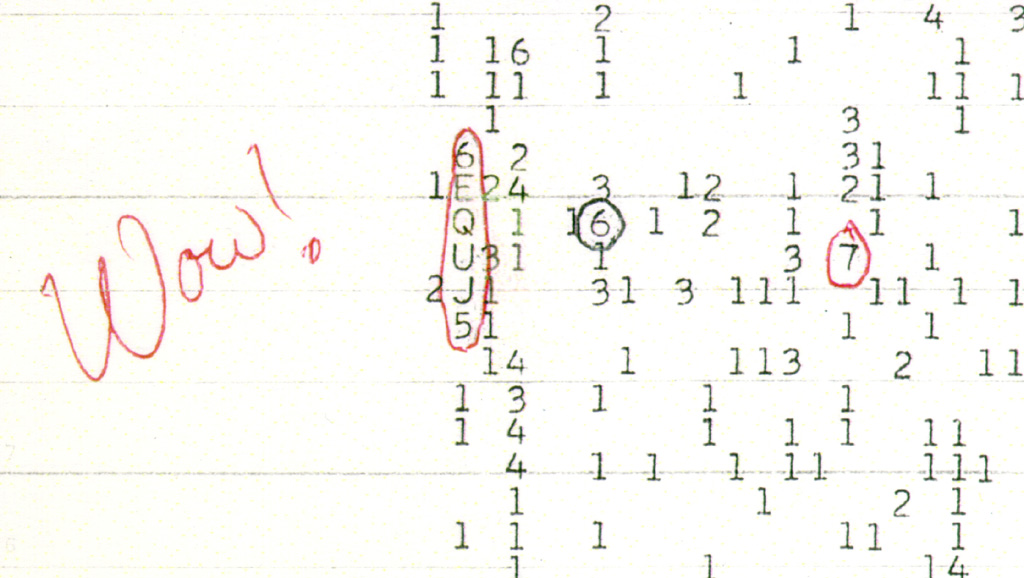
An oldie but a goodie. Perhaps the most famous 'strange signal' of all?
On August 15, 1977, Ohio State University's Big Ear radio telescope detected the Wow! Signal, a powerful, fleeting 72-second narrowband radio transmission from deep space.
Here are the key facts:
- Much of the search for extra terrestrial intelligence (SETI) focuses on the frequency 1420.406 MHz emitted by accelerated hydrogen atoms, the most common element in the Universe.
- Designed and built by Dr. John D. Kraus, the 3-acre Big Ear observatory looked like a car park with wire fences but was in fact a 52.5-metre traditional dish telescope.
- Big Ear began surveying the sky in 1963 and became the first full-time SETI program ten years later in 1973.
- On August 15, 1977 at 02:16 UTC, Big Ear picked up a signal originating near M55 in Sagittarius that was 30 times louder than baseline background noise.
- Three days after the detection, volunteer Jerry Ehman reviewed the computer printout, circled the six figures '6EQUJ5', and wrote "Wow!" next to them.
- 6EQUJ5 is an intensity scale where 'U' represents the peak value between 30 and 30.9, the largest ever recorded by the telescope.
- The narrowband nature of the signal indicated that its source had to be at least as far away as the Moon.
- Because only one feed horn picked up the signal, it created two potential points of origin northwest of M55, near Chi Sagittarii and south of the ecliptic.
- Follow-up searches by Big Ear, the META array and the Very Large Array failed to find the signal again.
- Suggested origins include comets or the Sun-like star 2MASS 19281982-2640123, but these remain unproven.
Read our full guide to the Wow! Signal
Weird X-ray from the Eye of God

A study found that a strange, decades-old X-ray signal coming from the white dwarf at the centre of the Eye of God Nebula (or the Helix Nebula) is caused by planetary debris from a Jupiter-like planet that was torn apart by the dying star. Mystery solved?
Here are the key facts:
- The Eye of God Nebula, or Helix Nebula, is a planetary nebula formed by a dying star that puffed out its outer layers and left behind a white dwarf core.
- Located 650 lightyears from Earth, the central white dwarf – named WD 2226-210 – is the closest planetary nebula to Earth.
- Since as far back as 1980, observatories like Einstein and ROSAT detected strange, highly energetic X-rays coming from WD 2226-210, which is unusual because white dwarfs do not normally emit strong X-rays.
- Armed with newer space observatories like NASA's Chandra and the ESA's XMM-Newton, a team of astronomers may have solved the mystery.
- The researchers propose that a large gas giant originally orbited far from the star, but migrated inward due to gravitational interactions with other planets. Eventually, it wandered too close.
- The white dwarf's gravity tore the Jupiter-like planet apart, making this potentially the first recorded case of a planet destroyed by a central star in a planetary nebula.
- The mysterious X-ray glow is generated when the shattered debris of the destroyed planet falls into the white dwarf and is intensely heated.
- Data revealing a subtle, regular change in the X-ray signal every 2.9 hours indicates that the remains of the planet are still orbiting close to the white dwarf.
- The destroyed body was determined to be a planet rather than a star because a star of that size would be too massive to be torn apart by the white dwarf.
- Because two other white dwarfs share similar X-ray emission traits, these systems could point to a newly-discovered class of astronomical objects.
Read our full report on the strange signal from the Eye of God
The signal from deep space lasting seven hours

In 2025, astronomers recorded GRB 250702B, a record-breaking, seven-hour-long gamma-ray burst that scientists believe was caused by a rare helium merger between a black hole and an orbiting helium star.
Here are the key facts:
- Gamma-ray bursts were discovered in the 1960s by US military satellites searching for secret nuclear detonations during the Cold War.
- Modern telescopes use wide-field, high-energy monitoring to scan the sky simultaneously and automatically alert researchers when bright flashes of gamma rays occur.
- Designated GRB 250702B, the signal consisted of three separate gamma-ray bursts that appeared to originate from the exact same location in the sky.
- By combining data from five high-energy telescopes, researchers calculated that the burst lasted approximately seven hours, or 25,000 seconds.
- This makes it the longest gamma-ray burst ever recorded, eclipsing the previous record holder of roughly 15,000 seconds.
- Typical gamma-ray bursts normally last no more than a few minutes and are usually triggered by either the collapse of a massive star into a black hole or the merger of two dense neutron stars.
- Because standard origins cannot account for its length, scientists theorise that GRB 250702B was caused by a helium merger, where a black hole enters an orbiting helium star's envelope and rapidly consumes it.
- Extremely long bursts are rarely spotted because they are dimmer, less common and harder for telescopes tuned to short, bright signals to detect.
Read our full interview with one of the scientists behind the discovery of GRB 250702B
Radio signals detected from an alien world
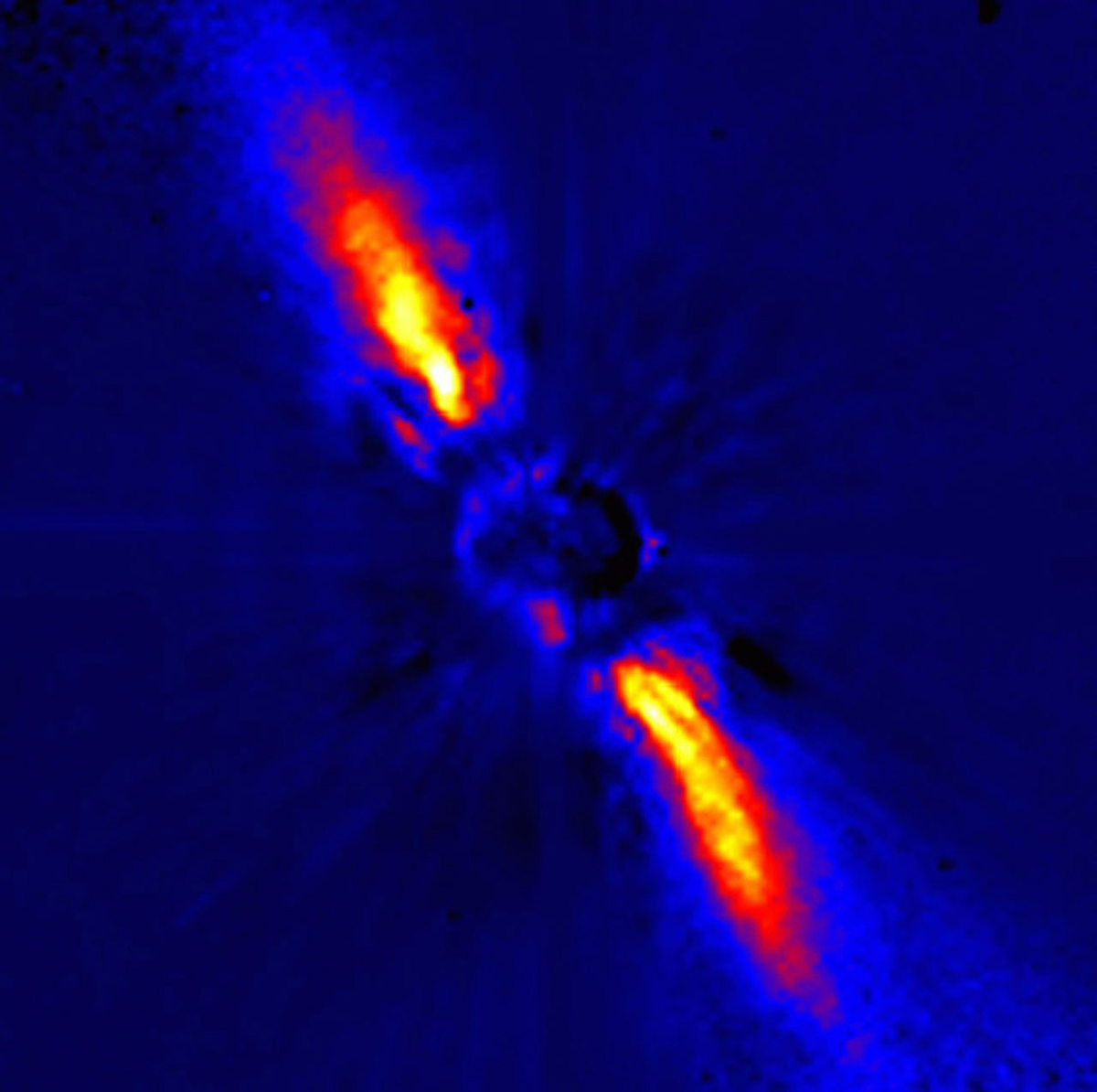
Researchers successfully detected variable radio bursts directly from Beta Pictoris b, a massive gas giant exoplanet located roughly 63 lightyears away from Earth.
It was the first signal ever detected from a planet beyond our Solar System.
Here are the key facts:
- Although detecting radio signals from space might sound like a sign of alien life, this discovery is a natural phenomenon rather than a message from E.T.
- The detection was made using South Africa’s 64-dish MeerKAT radio telescope array.
- It marked a major milestone because it was the first time a radio signal had been definitively traced to a single planet rather than an entire star system.
- Scientists were able to isolate the planet's faint signal because its host star, Beta Pictoris, is magnetically quiet.
- The radio emissions are driven by the same physics that create spectacular auroras on planets in our own Solar System, caused by charged particles spiralling along magnetic field lines.
- By analysing these radio waves, the team calculated that the exoplanet possesses a magnetic field that's thousands of times stronger than Earth's.
- Understanding planetary magnetic fields is vital because they act as protective shields, preventing fierce stellar winds from stripping away a planet's atmosphere.
- The discovery opens up a new way for astronomers to study distant gas giants and figure out which worlds across our Galaxy might be capable of hosting life.
Read our full report on the signals detected at Beta Pictoris b
Strange radio signals from the centre of our Galaxy

Astronomers using the Australian Square Kilometre Array Pathfinder discovered a highly unusual and polarised radio signal, designated ASKAP J173608.2-321635, near the centre of the Milky Way.
This strange signal doesn't match any known stellar or pulsar classification.
Here are the key facts.
- The mysterious radio signal, designated ASKAP J173608.2-321635, was discovered in early 2020 using the Australian Square Kilometre Array Pathfinder (ASKAP) telescope in Western Australia.
- The signal originated near the centre of our own Milky Way Galaxy and was found via the Variables and Slow Transits (VAST) survey, which is designed to spot radio sources that vary in brightness or turn on and off.
- The source was picked up a total of six times between January and September 2020.
- One of its strangest features is that it's highly polarised. This is a rare characteristic found in only about 10 out of thousands of sources in a typical observation.
- The signal behaves irregularly, turning on and off with brightness levels that can decline dramatically within a single day or last for a few weeks.
- Although researchers considered stars as a potential explanation, the signal is far too bright to be a star and produces nothing detectable in infrared wavelengths.
- Despite sharing certain traits with pulsars and magnetars, observations revealed no evidence of short-timescale radio pulsations or any corresponding X-ray emissions.
- Researchers carried out follow-up observations using the Parkes, MeerKAT, Neil Gehrels Swift, Chandra and Gemini telescopes, but found nothing outside of the intermittent radio data.
- While the signal shares similarities with mysterious Galactic Centre Radio Transients (GCRTs), the timescale of its bursts is not consistent with them.
- Astronomers hope that future observations with the more powerful Square Kilometre Array will eventually help pin down the true nature and behaviour of the signal.
Read our full interview with one of the scientists behind the discovery of ASKAP J173608.2-321635.
Variable radio and x-ray signals never seen before
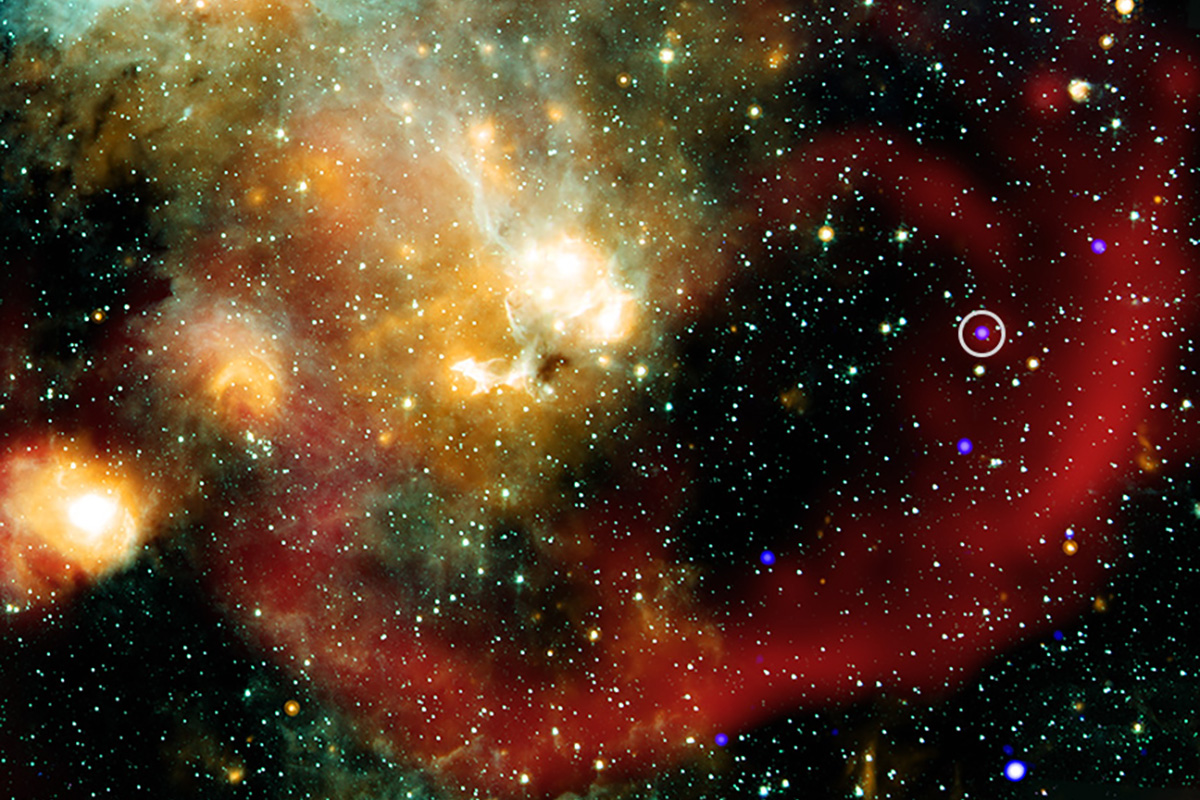
Astronomers discovered a cosmic object named ASKAP J1832 that pulses with mysterious radio and X-ray signals every 44 minutes.
Here are the key facts
- Located 15,000 lightyears away from Earth, the object is named ASKAP J1832-0911, or ASKAP J1832 for short.
- It belongs to a rare group of deep-space objects known as 'long period radio transients', which were first discovered in 2022.
- While typical pulsars flash like celestial lighthouses every few seconds, ASKAP J1832 cycles in radio wave intensity much more slowly, taking 44 minutes per cycle.
- Researchers discovered that the object also emits regular X-ray pulses every 44 minutes, marking the first time this type of X-ray behaviour has been seen in a long period radio transient.
- The discovery was made using NASA's Chandra X-ray Observatory and Australia's Square Kilometer Array Pathfinder radio telescope.
- Adding to the mystery, both the radio and X-ray signals dropped off substantially over a period of six months.
- Although scientists have considered various theories, including an old magnetar with a massive magnetic field or a neutron star, none of the standard explanations completely matches what they saw.
- While the object appears to sit inside the glowing wreckage of an exploded star (a supernova remnant), astronomers believe this is just an accidental alignment from our view on Earth rather than a true physical connection.
- An isolated white dwarf star does not fit the data either, though researchers suggest a white dwarf paired up with a companion star remains a possibility.
Read our full report on the discovery of ASKAP J1832
The star with unexplained light changes

Tabby’s Star is a mysterious celestial object that baffles astronomers with dramatic, unpredictable drops in its light.
That has left room for explanations ranging from the rather mundane – unusual dust clouds – to the much more speculative – alien megastructures.
Here are the key facts
- Unlike other entries on our list, Tabby’s Star involves unusual light signals rather than radio waves.
- While stars normally either brighten until they go supernova or slowly dim into white dwarfs, this star behaves differently.
- Tabby’s Star experiences dramatic, irregular drops in brightness that can plunge by up to 22%.
- These sudden light dips happen with no clear pattern and are far too large to be caused by a passing exoplanet.
- A year after its discovery, analysis concluded that no known or proposed stellar phenomena can fully explain all aspects of its observed light curve.
- Scientists have proposed various explanations for the phenomenon, including swarms of comets and a leading theory involving dust clouds.
- However, James Webb Space Telescope data from 2024–25 revealed that this dust is strangely cold and too localised to provide a definitive answer.
- This lingering mystery leaves the door open to more speculative concepts, such as a massive alien megastructure.
- Although the alien megastructure hypothesis sits towards the edge of scientific respectability, it has still not been conclusively ruled out.
- Astronomers are still actively searching for other similar 'weirdo' stars, though nothing has been found yet.
Find out more about Tabby's Star in our guide to strange signals we thought were aliens