Since February 1998 – when it surpassed the previous record-holder, NASA’s outer-planet explorer Pioneer 10 – Voyager 1 has been the farthest human-made object in existence.
Even now, more than 48 years since launch, the probe is still sending back science.
This tiny emissary of humankind is fast approaching another staggering milestone. Around 13 November in 2026, it will be exactly one ‘light-day’ from Earth, a light-day being the distance light travels in a vacuum in 24 hours.
At that moment, the intrepid spacecraft will be almost 25.9 billion kilometres (16.1 billion miles) from home.
More incredible spaceflight

Voyager 1 is travelling at about 61,000km/h (38,000mph) towards a point in the constellation of Ophiuchus.
NASA estimates that in the year 40,272 it will pass within 1.7 lightyears of the faint red dwarf star Gliese 445, currently in the constellation Camelopardalis.
Like its sister ship Voyager 2, it left Earth carrying a message for aliens, the famous Golden Record.
Launched in September 1977, Voyager 1 flew by Jupiter in 1979, then Saturn in late 1980.
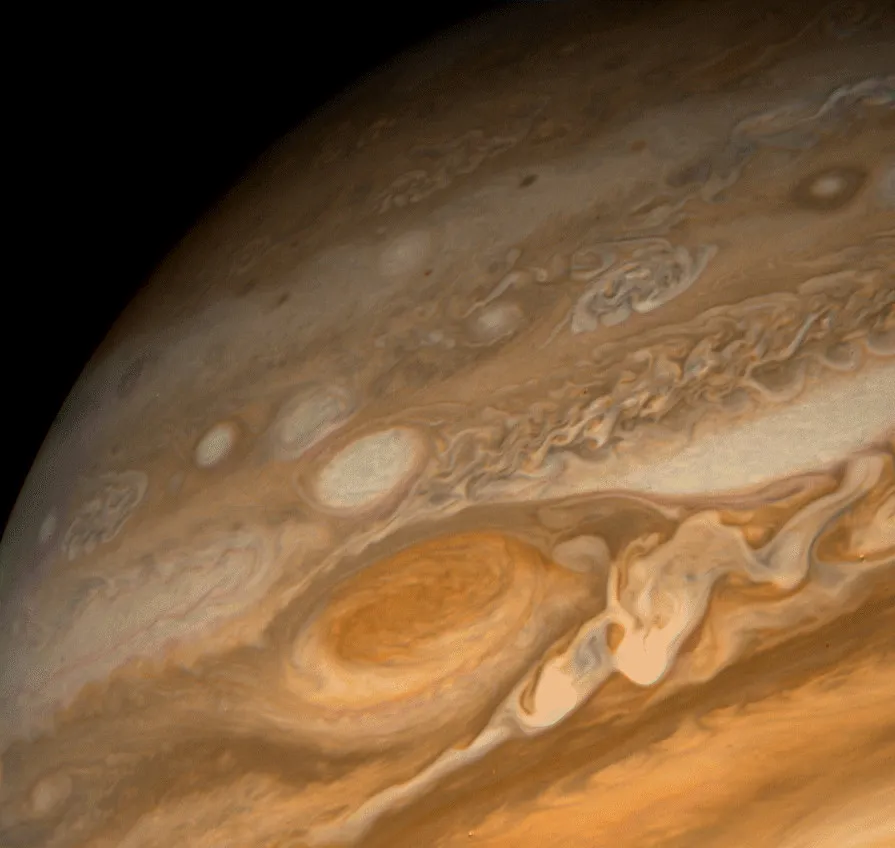
At Jupiter, a slingshot manoeuvre allowed it to study the four Galilean moons (Io, Europa, Ganymede and Callisto), as well as the gas giant itself.
The Voyagers discovered volcanic activity on Io, water-ice on Europa and the thin Jovian ring system.

Journey to the edge of the Solar System
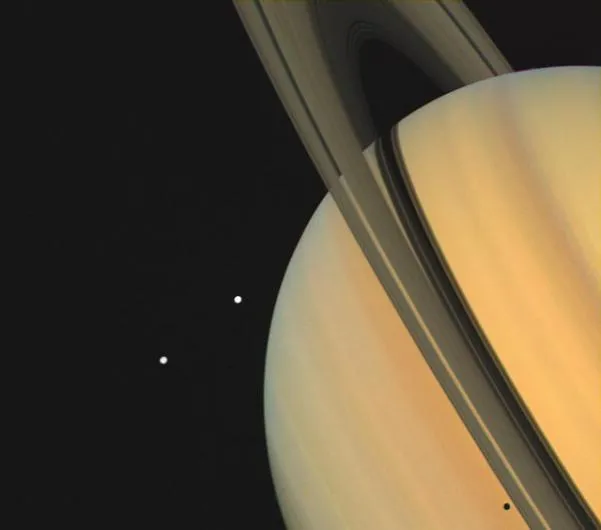
At Saturn, Voyager 1 discovered five previously unknown moons, revealed the complexity of the ring system and showed that its moon Titan is shrouded in a thick, hazy atmosphere of nitrogen.
It has already achieved so many firsts on its way to the distant stars.
In 2004, it reached the termination shock, where the solar wind begins to slow due to pressure from interstellar space.
On 25 August 2012, it crossed the heliopause, a vast cocoon around the Sun within which space is dominated by the solar wind and the Sun’s magnetic field.
The heliopause is where the Sun’s influence is much reduced compared to the interstellar medium (ISM).
However, Voyager 1 is not yet really at the ‘edge’ of the Solar System.
Far beyond the heliopause lies the Oort cloud, a reservoir of countless icy planetesimals gravitationally bound to the Sun.
Voyager 1 has still not encountered that cloud and won’t do so for another 300 years or so.
Even then, it will take another 30,000 years for it to traverse this region and be truly outside the Solar System.
In December 2018, NASA scientists announced that Voyager 1 had detected the constant drone of vibrations in the ionised gas of the ISM.
Even though well beyond the heliopause, in 2020 the probe encountered a strange increase in magnetic field, perhaps indicating that the Sun’s magnetic activity can occasionally expand the heliopause.
Voyager 1 generates its power from the heat of radioactive decay.
Since its nuclear fuel, plutonium-238, decays over time, the power generated now is only about half that at launch.
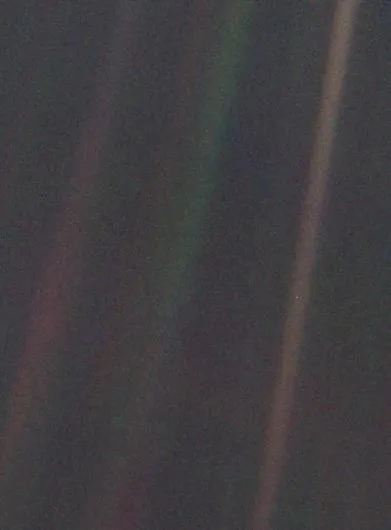
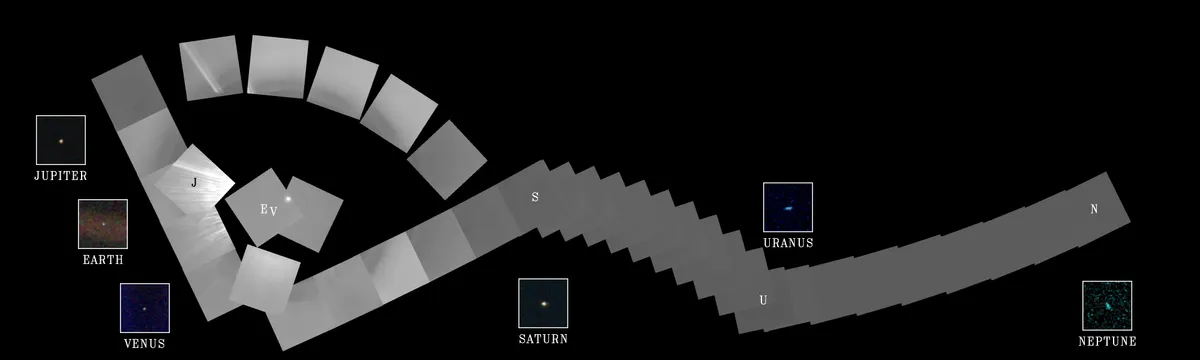
Many of the probe’s instruments have been switched off to conserve energy. The cameras took their final images in 1990, looking back towards the inner Solar System, snapping all the planets except Mercury (which was too close to the Sun).
Losing science and communication
The instruments that are still working and still powered up are a magnetometer, a device to measure electron density and another that measures low-energy particles.
These are the instruments that are most relevant to studying the ISM.
Eventually, communication with Voyager 1 will be lost. At some point, the attitude-correction thrusters that keep its antenna pointed at Earth will stop working.
By 2036, the probe will be so distant that NASA antennas will no longer be able to detect its faint signal.

After that, Voyager 1 will be on its own, left to wander the Milky Way for aeons to come.
When it reaches its one light-day from Earth milestone in November 2026, it will be 5.6 times farther away than Neptune.
That’s a staggering distance – but it’s more astonishing to realise that in its 48-year journey to get there, Voyager 1 will have travelled only 0.0027 per cent of the distance to the Sun’s nearest star, Proxima Centauri.

How we communicate with Voyager 1
Voyager 1 was built with what now feels like ancient technology, but was the best the 1970s could offer.
Its three computers have just 68 kilobytes of memory between them and their CPUs run at only 250kHz.
Commands sent to the probe are uplinked at a meagre 16 bits per second (bps), while scientific data arrives at Earth (downlinked) typically at 160bps.
That’s about half a million times slower than your typical domestic broadband connection.
Voyager’s extreme remoteness and age make communications difficult.
In late 2023, the probe began sending gibberish back to Earth. It took NASA engineers five months to diagnose and fix the problem – unsurprisingly, it turned out to be a failed memory chip.
What are your favourite memories from the Voyager missions? Let us know by emailing contactus@skyatnightmagazine.com